Islamic Age Calculator
Find your exact age in the Islamic (Hijri) calendar — years, months and days — alongside your Gregorian age, the day you were born, your next Hijri birthday, and your age of religious maturity (bulugh).
Free Hijri Age Calculator
Enter your date of birth to reveal your Islamic lunar age and much more
What Is Islamic (Hijri) Age?
📊 Hijri Age — Quick Facts
The essentials behind your age in the Islamic lunar calendar
*Fallback age when physical signs of puberty are absent — schools differ (see below).
Your Islamic age — also called your Hijri age or lunar age — is your age measured by the Islamic (Hijri) calendar rather than the Gregorian calendar used for civil purposes. Because the Hijri calendar is purely lunar, each year is roughly 11 days shorter than a solar year. Those days quietly add up, so your Hijri age is always a little higher than your Gregorian age.
The Islamic calendar counts years from the Hijra (هِجْرة) — the migration of the Prophet Muhammad ﷺ from Mecca to Medina in 622 CE — which is why Hijri years carry the suffix AH (Anno Hegirae, “in the year of the Hijra”). Knowing your age this way connects your personal timeline to the rhythm of Islamic worship: Ramadan, the two Eids, and the sacred months all follow this same lunar count.
إِنَّ عِدَّةَ ٱلشُّهُورِ عِندَ ٱللَّهِ ٱثْنَا عَشَرَ شَهْرًا
“Indeed, the number of months with Allah is twelve [lunar] months in the register of Allah [from] the day He created the heavens and the earth…”
— Qur’an, Surah At-Tawbah 9:36 · Read on Quran.com ↗
This verse anchors the twelve-month lunar system that defines the Hijri year — and therefore your Islamic age. The calculator above uses the same tabular Hijri engine as our Hijri Date Converter, so the birth date it shows will match across both tools.
Why Your Hijri Age Is Higher Than Your Gregorian Age
The gap comes down to a simple, beautiful fact of astronomy: the moon moves faster than the sun through our calendars.
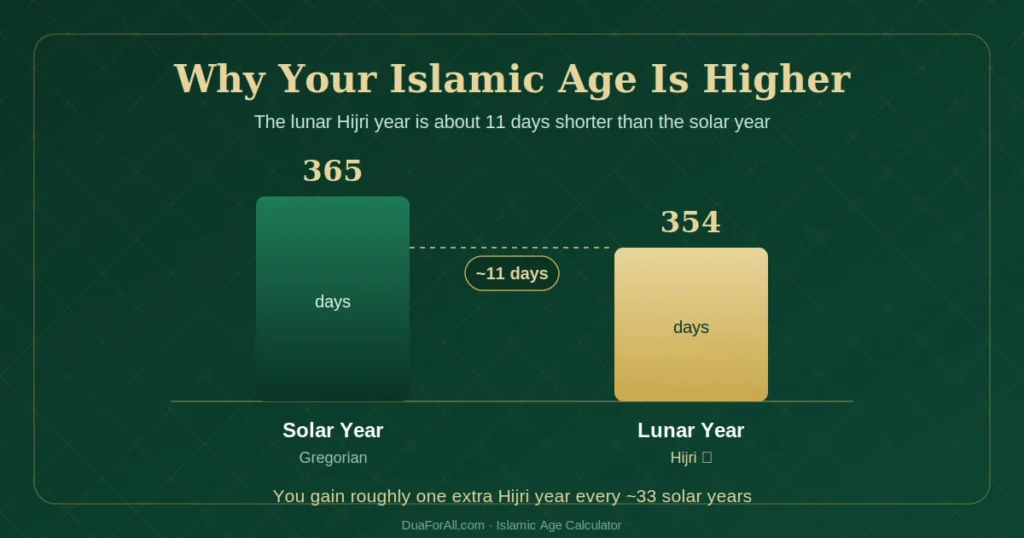
📊 Lunar Year vs Solar Year — The 11-Day Gap
Each Hijri year is ~11 days shorter, so lunar age pulls ahead over time
A Gregorian (solar) year tracks the Earth’s journey around the sun and lasts about 365.25 days. A Hijri (lunar) year tracks twelve cycles of the moon and lasts about 354.37 days. The difference — roughly 11 days a year — means Islamic dates drift earlier through the seasons and, crucially, that your lunar age climbs slightly faster than your solar age.
Over a lifetime this is easy to feel: someone who is 33 solar years old is already about 34 Hijri years old. By the time a person reaches their seventies in solar years, they may be two full years older in the Hijri reckoning. The calculator above works this out to the exact day for you.
Why Your Hijri Age Matters
Islamic age is not just a curiosity — it marks real turning points in a Muslim’s religious life.
Prayer & Fasting
The five daily prayers and fasting in Ramadan become obligatory upon reaching maturity (bulugh), which is measured in lunar years. Knowing your Hijri age helps identify that threshold.
Zakat & the Lunar Year
Zakat is due once wealth is held for a full lunar year (hawl), and in most schools becomes relevant at maturity. Pair this with our Zakat Calculator.
Hajj & Life Events
Hajj is obligatory once for every able adult Muslim. Milestones such as marriage and guardianship in Islamic law are also framed by maturity, not calendar birthdays.
Marking Birthdays & ʿUmr
Many families like to note their Hijri birthday to stay connected to the Islamic year — and to remember that time itself is a trust (amānah) from Allah.
The Age of Maturity (Bulugh) in Islam
In Islam, a child becomes mukallaf — legally responsible for religious duties — upon reaching bulugh (بُلُوغ), the age of maturity. Here is how the scholars define it.
Maturity is established first and foremost by physical signs of puberty. When those signs appear, the person is considered an adult in Islamic law regardless of their number of birthdays. Only when no physical sign has appeared do the jurists fall back on a set age, and it is here that the schools differ.
وَإِذَا بَلَغَ ٱلْأَطْفَٰلُ مِنكُمُ ٱلْحُلُمَ فَلْيَسْتَـْٔذِنُوا۟
“And when the children among you reach puberty (al-hulum), let them ask permission [before entering]…”
— Qur’an, Surah An-Nur 24:59 · Read on Quran.com ↗
The primary signs of bulugh
- For boys and girls: the emission of maniyy (sexual fluid), whether awake or through a wet dream (iḥtilām), and the growth of coarse pubic hair.
- For girls additionally: the onset of menstruation (ḥayḍ), or pregnancy.
The Qur’an also ties the release of an orphan’s property to reaching maturity together with sound judgement (rushd): “And test the orphans until they reach marriageable age; then if you perceive in them sound judgement, release their property to them” (Qur’an 4:6).
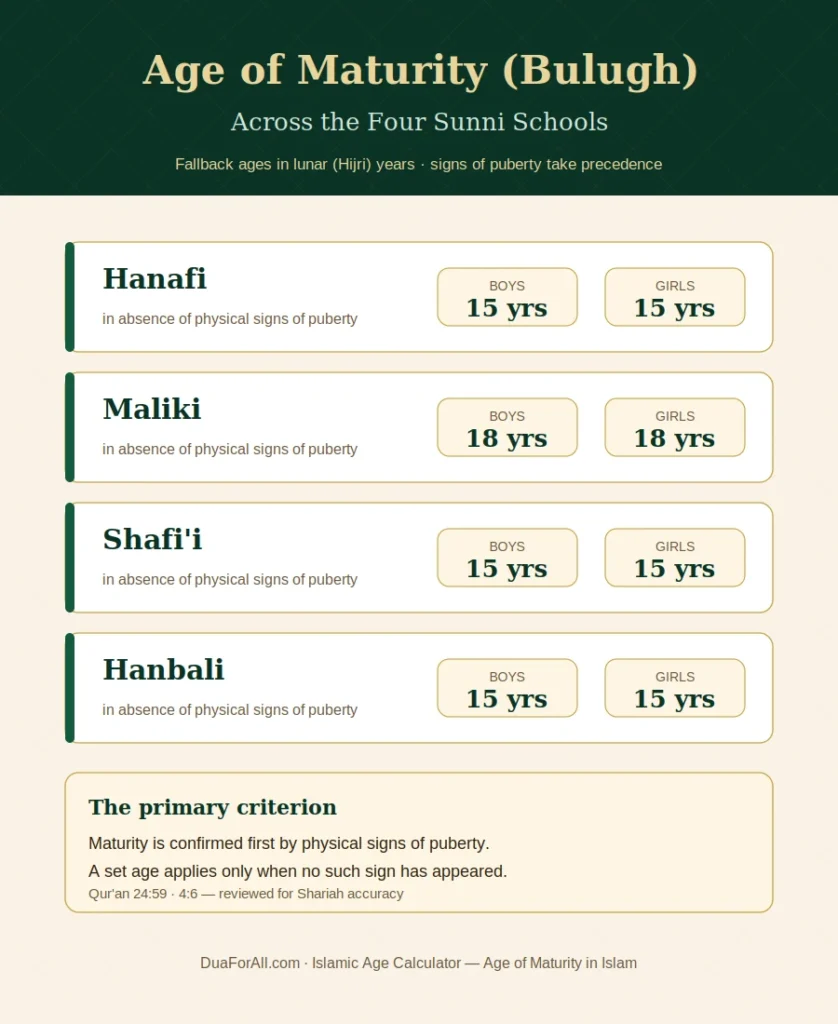
📊 Fallback Age of Maturity Across the Four Madhabs
Applied only when no physical sign of puberty is present · ages are in lunar (Hijri) years
| School (Madhab) | Boys | Girls | Notes |
|---|---|---|---|
| Hanafī | 15 years | 15 years | The relied-upon (mu’tamad) position. Imam Abū Ḥanīfa’s earlier view was 18 for boys and 17 for girls; the fatwa follows his two companions at 15. |
| Mālikī | 18 years | 18 years | A well-known Mālikī position; some narrations mention 17. Physical signs still take precedence. |
| Shāfiʿī | 15 years | 15 years | Completion of 15 lunar years in the absence of signs. |
| Ḥanbalī | 15 years | 15 years | Completion of 15 lunar years in the absence of signs. |
Menstruation in a girl is generally recognised as a sign of maturity from around 9 lunar years; for boys, puberty by age alone is typically not assumed before around 12 lunar years. These are scholarly minimums, not obligations.
Key Age Milestones in a Muslim’s Life
Islamic upbringing (tarbiyah) recognises stages, not a single switch. These ages are counted in lunar years.
Begin teaching prayer
Children are commanded to be taught and encouraged to pray from the age of seven. The Prophet ﷺ said: “Command your children to pray when they are seven…” Sunan Abī Dāwūd 495 Hasan
Firmer encouragement toward prayer
By ten, the same hadith directs guardians to be firmer in establishing the habit of prayer and to separate children’s sleeping arrangements — a stage of consolidating good practice before responsibility begins.
Religious obligations begin
Upon maturity (by signs, or the fallback age above), prayer, fasting Ramadan, and the full duties of Islam become obligatory. The person is now mukallaf — accountable for their deeds.
How This Islamic Age Calculator Works
The calculator converts your Gregorian date of birth (or Hijri, if you choose that mode) into a Julian Day Number, then into the tabular (arithmetic) Islamic calendar — the same mathematically consistent engine that powers our Hijri Date Converter. It then computes the difference between your birth date and the target date (today by default), carefully borrowing across variable Hijri month lengths of 29 or 30 days.
On accuracy: the tabular calendar is accurate to within ±1–2 days of the observed, moon-sighted calendar. Your age difference — years, months and days — is highly reliable because any small offset largely cancels out between the two dates. Only the exact displayed Hijri date may shift by a day depending on moon sighting in your region. For religious observances such as the start of Ramadan or the two Eids, always confirm with your local mosque or Islamic authority.
Frequently Asked Questions
An Islamic (Hijri) age calculator converts your date of birth into your age according to the Islamic lunar calendar. Because a Hijri year is about 11 days shorter than a Gregorian year, your Islamic age is slightly higher than your Gregorian age — roughly one extra year for every 33 years of life. This tool also shows the day you were born, your total days lived, and your next Hijri birthday.
The Hijri year has 354–355 days versus the Gregorian year’s 365–366 days — a difference of about 11 days. Over time these days accumulate, so a person gains roughly one additional Hijri year approximately every 33 solar years. That is why the lunar count always runs a little ahead.
Bulugh is the age at which a Muslim becomes legally responsible (mukallaf) for religious duties such as prayer and fasting. It is established primarily by physical signs of puberty. When no such signs appear, the Shāfiʿī, Ḥanbalī and later Ḥanafī schools set the age at 15 lunar years, while the Mālikī school commonly sets it at 18 lunar years. Physical signs always take precedence over a set age.
They become obligatory upon reaching bulugh (puberty). Children are commanded to begin praying at seven as training — based on a hadith in Sunan Abī Dāwūd graded Hasan — but the obligation itself, along with accountability, begins at maturity. Fasting Ramadan follows the same rule, with gradual practice encouraged beforehand.
Yes. Switch the calculator to the “Born (Hijri)” mode and enter your Hijri day, month and year. The tool will compute your Hijri and Gregorian age and also show your Gregorian date of birth for reference.
The calculator uses the tabular (arithmetic) Islamic calendar, the same engine as our Hijri Date Converter. It is accurate to within ±1–2 days of moon-sighted dates. The age difference itself (years, months, days) is highly reliable; only the exact displayed Hijri date may shift by a day depending on local moon sighting.
Indirectly, yes. Zakat is calculated on a lunar year (hawl) and, in most schools, applies once a person reaches maturity. Whether a minor’s wealth is zakatable differs by madhab. To work out an actual amount, use our Zakat Calculator, which handles the 2.5% rate and nisab thresholds.
Author & Shariah Reviewer
Hadith graded per classical scholarship · Madhab differences noted · See our Editorial Standards.
Authoritative References
For deeper study of maturity, the lunar calendar and related rulings, we recommend these trusted sources:
Explore More on DuaForAll
☾ جَزَاكَ اللَّهُ خَيْرًا
Bookmark this Islamic Age Calculator and share it with your family. Reminding one another of time is a means of reflection.
🗓️ Calculate My Age 📿 Daily Duas ☾ Hijri Converter⚠️ This Islamic Age Calculator is an educational tool. Hijri dates use the tabular (arithmetic) calendar and may vary by ±1–2 days from moon-sighted dates. Rulings on maturity (bulugh) and obligations are summarised from the four Sunni schools and are not a fatwa — for personal rulings, consult a qualified scholar. This tool does not replace scholarly guidance.
Content by DuaForAll.com · Reviewed for Shariah accuracy · · Dates are calculated (tabular); verify with local authority for religious observances. | ↑ Back to top